Radon Mitigation Cost in the Philadelphia Area
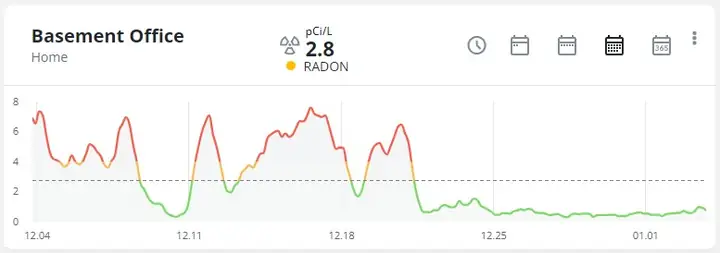
Step 1: test, then confirm
- Kits: PA DEP says a home test kit costs "about $20 to $30." HomeGuide (national) puts DIY kits at $10 to $50, and professional testing at $125 to $400 on average. Angi (national) gives $150–$700 for radon testing.
- Where to test: DEP says radon "levels are often highest in the basement," but homes without basements should test the ground floor. It says the best time to test is the colder months.
- Confirm a high result: if a test is above 4 pCi/L, DEP suggests a second test. For results of 4–8 pCi/L, that can be a long-term (365-day) test or another short-term test. If the result is "still 4 pCi/L or higher, you should take corrective action."
- Free DEP kits: DEP sends a free confirmation kit if a screening test found more than 100 picocuries per liter. It also sends a free long-term kit if an active (fan-powered) system was installed in your home within the last year. You'll need proof of installation and a post-mitigation result below 4 picocuries per liter. Call DEP's Radon Hotline at 800-237-2366.
What the numbers mean (EPA)
| Radon level | EPA says |
|---|---|
| 4 pCi/L or higher | Fix your home |
| 2 to 4 pCi/L | Consider fixing |
| 1.3 pCi/L | Average indoor radon level |
| 0.4 pCi/L | Average outdoor radon level |
Source: EPA, Health Risk of Radon. EPA also notes that "Reducing radon levels below 2 pCi/L" is difficult. It estimates radon causes about 21,000 lung cancer deaths a year in the U.S.
What a radon mitigation system costs
| Source | Average | Typical range | Low / high |
|---|---|---|---|
| Angi, national (updated Sep 28, 2026) | $1,043 | $805–$1,326 | — |
| HomeGuide, national (Feb 5, 2026) | $1,600 | $1,200 to $2,000 | $500 / $8,000 |
| Angi, Philadelphia page (updated Feb 26, 2026) | $869 | $677–$1,066 | $420 / $1,550 |
Sources: Angi national; HomeGuide; Angi Philadelphia. Angi says its national figures are "based on data from 1,184 verified projects." HomeGuide calls its figures installed costs.
EPA doesn't give a price. It says "Most homes can be fixed for about the same cost as other common home repairs" (EPA).
Our reading: the Angi Philadelphia average ($869) is lower than Angi's own national average ($1,043), and the Philadelphia page was last updated earlier in the year. We couldn't confirm how Angi calculated it, so treat it as a rough local estimate.
By system type
| System | Angi national | Angi Philadelphia page | HomeGuide national |
|---|---|---|---|
| Active soil depressurization (fan and pipe under the slab) | $1,000–$3,000 | $843–$2,529 | $1,200 – $2,000 |
| Passive depressurization | $500–$2,500 | $421–$2,107 | — |
| Wall-based systems | $500–$3,000 | $421–$2,529 | $500 – $3,000 |
| Ventilation systems | $1,300–$2,500 | $1,096–$2,107 | $1,300 – $2,500 |
| Sealing the basement | $400–$4,600 | $337–$3,877 | — |
| Water mitigation (radon in well water) | $1,200–$5,000 | $1,011–$4,215 | $1,200 – $5,000 |
Conflict in Angi's national page: its summary says active suction soil depressurization "costs $805 to $1,326," but its method table lists $1,000–$3,000 for the same method. We show the table figure and flag the difference.
HomeGuide says an active soil depressurization system "can cost $2,500+ for larger homes." It lists sump pit sealing and a cover at $900 to $2,500 and block-wall depressurization at $1,800 to $3,000 (national).
Other costs
- Bigger homes: Angi adds $500–$1,500 for larger homes (national). Its Philadelphia page says an extra $421 to $1,264.
- Permits: Angi (national) says $25–$150. Its Philadelphia page says to expect "around $150 for an electrical permit."
- Electricity: HomeGuide says the fan uses about as much as a 60-watt bulb, "around $70 to $80 per year." Angi (national) says $100–$300 per year.
- Fan replacement: HomeGuide says the fan may need repair or replacement "after 5 to 10 years," while the piping lasts 20 to 50+ years.
- Warranties: Angi (national) lists extended warranties at $200–$500.
Who can install it
| Where | Rule | Source |
|---|---|---|
| Pennsylvania | No one may mitigate radon "unless the person has first applied for and obtained certification from the Department" (DEP) or works for a certified firm. DEP keeps a Radon Services Directory of certified mitigators by county, updated monthly. | 25 Pa. Code § 240.111 |
| Pennsylvania homeowners | The rules don't apply to someone "Testing for or mitigating against radon contamination in a building that the person owns or in which the person resides." | 25 Pa. Code § 240.2 |
| New Jersey | Certification "is mandatory in New Jersey for any business or individual performing radon testing or mitigation services in buildings." It doesn't apply to "An individual performing testing or mitigation on a building he or she owns." | N.J.A.C. 7:28-27.1 |
| New Jersey permits | The state's "minor work" category includes "The installation of a radon mitigation system provided no new electrical work is required" and the installation doesn't penetrate a fire-resistance rated assembly. Ask your construction office what applies if a new circuit is needed. | N.J.A.C. 5:23-2.17A |
| Philadelphia | Angi's Philadelphia page says the work needs an electrical permit. L&I's electrical permit fee is "$25 for each $1000 or fraction thereof of estimated electrical construction cost," with a $63 minimum, a $100 filing fee counted toward the permit fee, and $3 city and $4.50 state surcharges. We couldn't confirm from L&I whether every radon installation needs one. | L&I electrical permit |
After it's installed
- DEP says installation "should take less than a day." After the system has run "for at least 24 hours," the installer should do a follow-up test.
- Check the U-tube manometer on the pipe now and then. DEP says if the fluid levels on both sides are even, the fan may not be working.
- DEP recommends retesting "once every two years," in the basement, preferably during the heating season.
Questions to ask before you sign
- Certification: What is your DEP (or New Jersey) certification number? Check it in the state's directory.
- Design: How many suction points does my home need, and where will the pipe and fan go?
- Sealing: Will you seal the sump pit and major cracks, and is that included?
- Testing: Does the price include a post-installation test, and who does it?
- Electrical: Is there an outlet for the fan, or do I need a new circuit and permit?
- Guarantee: What level do you guarantee, and what happens if a retest is still high?
- Warranty: What does the warranty cover for the fan and the installation, and for how long?
If you also have water coming into the basement, our sump pump guide covers pumps and basement water.
FAQ
How much does radon mitigation cost in Philadelphia? Angi's Philadelphia page gives an average of $869 and a range of $677–$1,066. National averages from Angi ($1,043) and HomeGuide ($1,600) are higher. Get written quotes for your home.
Do I need to fix radon at 3 pCi/L? EPA says to consider fixing between 2 and 4 pCi/L, and to fix at 4 pCi/L or higher.
Can I install a radon system myself? Pennsylvania's and New Jersey's certification rules exempt owners working on their own home. Angi says it is "never a project to attempt yourself," and DEP tells homeowners with high results to have a certified contractor install the system and do a follow-up test.
How often should I retest? PA DEP recommends testing a mitigated home once every two years.
Thinking about a project?
We don't offer quotes or connect homeowners with contractors. Get at least two written, itemized quotes from state-certified radon mitigation contractors, and compare them with the questions above. The costs and rules in this guide come from the sources listed below. Learn how we make money.
Sources
- Pennsylvania DEP, Radon in the Home: https://www.pa.gov/agencies/dep/programs-and-services/radiation-protection/radon-division/radon-in-the-home
- Pennsylvania DEP, news release, Jan 12, 2026: https://www.pa.gov/agencies/dep/newsroom/2026-01-12-dep-encourages-pennsylvanians-to-test-their-homes-for-radon-during-radon-action-month
- Pennsylvania DEP, Radon Services Directory: https://www.pa.gov/agencies/dep/programs-and-services/radiation-protection/radon-division/radon-services-directory
- 25 Pa. Code § 240.111: https://www.pacodeandbulletin.gov/secure/pacode/data/025/chapter240/s240.111.html
- 25 Pa. Code § 240.2 (via Cornell LII): https://www.law.cornell.edu/regulations/pennsylvania/25-Pa-Code-SS-240-2
- New Jersey DEP, N.J.A.C. 7:28-27 (courtesy copy): https://www.nj.gov/dep/rpp/RPRP_Rules/sub27.pdf
- N.J.A.C. 5:23-2.17A (via Cornell LII): https://www.law.cornell.edu/regulations/new-jersey/N-J-A-C-5-23-2-17A
- U.S. EPA, Health Risk of Radon: https://www.epa.gov/radon/health-risk-radon
- U.S. EPA, How much can a radon mitigation system cost?: https://www.epa.gov/radon/how-much-can-radon-mitigation-system-cost
- Angi, How Much Does a Radon Mitigation System Cost? (updated Sep 28, 2026; national): https://www.angi.com/articles/how-much-does-it-cost-remove-radon-gas.htm
- Angi, Radon Mitigation System Cost in Philadelphia, PA (updated Feb 26, 2026): https://www.angi.com/articles/how-much-does-it-cost-remove-radon-gas/pa/philadelphia
- HomeGuide, Radon Mitigation Cost (Feb 5, 2026; national): https://homeguide.com/costs/radon-mitigation-cost
- HomeGuide, Radon Testing Cost (Aug 23, 2023; national): https://homeguide.com/costs/radon-testing-cost
- City of Philadelphia, Get an Electrical Permit: https://www.phila.gov/services/permits-violations-licenses/apply-for-a-permit/building-and-repair-permits/get-an-electrical-permit/